
- 7696551555
- peoplespropertypoint@gmail.com
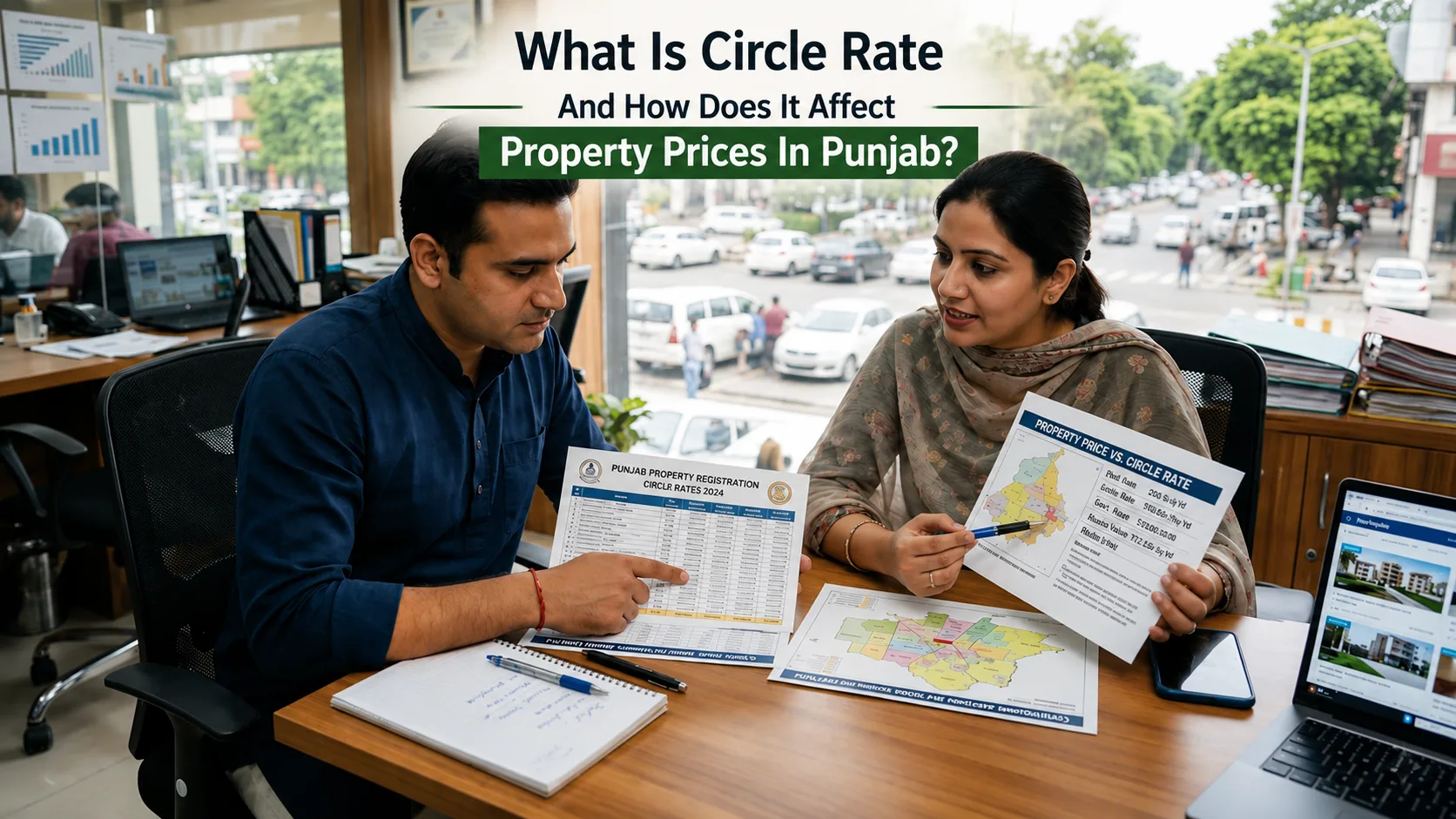
If you have any plans to purchase or sell property in Punjab, particularly from the cities like Mohali, Zirakpur, Panchkula, or Chandigarh tricity, you might find yourself repeatedly hearing about circle rate. Though everyone hears about it while getting their properties registered, not many actually know how it affects the total cost of a property transaction.
Read more: What Is Circle Rate And How Does It Affect Property Prices In Punjab?The circle rate is one of the main factors that influence the calculation of stamp duty and registration charges, as well as the appreciation of properties in the long term. Be it a buyer, seller, or investor, knowledge of circle rates will be helpful for you. This blog explains what circle rates are and how they affect property prices in Punjab.
The circle rate in Punjab, which is otherwise referred to as the collector rate or guidance value, is the minimum valuation required for registering properties. These circle rates have been fixed by the Department of Revenue of Punjab for different locations and property categories.
Even if both the parties arrive at an agreed price that is lower, the property cannot be registered by the Government authorities under the circle rate fixed by them for the area concerned.
The circle rates differ depending upon the location, development, and infrastructure of the place. For instance, a residential plot in a premium sector of Mohali will have a higher circle rate if you compare it to one that is located in outskirts of Zirakpur.

The government of Punjab divides locations on the basis of their development and commercial activities. Fully developed urban places are placed in better categories, whereas semi-urban and rural areas receive relatively low circle rates.
There are some criteria that affect circle rates:
Location proximity to big cities such as Chandigarh, Mohali, and Panchkula.
Those areas located closer to Aerocity Mohali, IT City, and other major GMADA areas possess relatively high circle rates due to infrastructural development and investment demand in the area.
One of the major effects of circle rate is the stamp duty calculation.
In Punjab, the stamp duty is charged on whichever value is higher:
the actual transaction price,
or the notified circle rate
For instance, in case one buys real estate property in Zirakpur, the market price of which is ₹50 lakh, whereas the circle rate estimates its value to be ₹60 lakh, then the stamp duty will be charged on ₹60 lakh.
It thus becomes essential for buyers to inquire about collector rates before purchasing any property.
The circle rates impact the entire property market. In areas where there is a demand, such as in Mohali or Panchkula, the increase in circle rates indicates increasing property prices in Punjab. Usually, the sellers raise the price according to the revised circle rates.
While the market price depends on the actual demand and supply, the circle rates provide the benchmark prices in the market.
Circle rates are also taken into account by banks when approving loans for homes.
If there is a large difference between the market rate and the collector rate, then the lenders would lend an amount based on the official standards. Thus, the buyer will have to contribute more money out of his pocket.
This is especially true in cases where the area is premium and there is a wide gap between market and government rates.
Increasing trends in circle rates are generally considered to be the signs of appreciation in the future.
The trend for increasing collector rates by the government in new regions such as Aerocity, New Chandigarh, or Zirakpur suggests that the region is going to witness development soon, which is followed by increased prices.
A lot of people actually confuse circle rate with market rate but these two are very different.
This is the minimum rate set by the government for purposes of property registration and valuation.
This is the rate which actually exists in the market after negotiations between buyers and sellers.
Market price in majority of the prime areas of Mohali, Panchkula, and Chandigarh tricity would normally be higher as compared to the circle rates. The variation between these two values is termed as a premium.
To explain the matter in detail, a land may have a circle rate set by the government at ₹70 lakhs, but its market value will be ₹90 lakhs due to increased demand.
The knowledge about circle rates enables buyers to do the following:
First-time buyers tend to consider only the price involved in buying property but not the other costs associated with circle rates.
The circle rate is just as crucial for the seller.
While the rise in collector rates will increase market value perceptions in favor of property owners, unreasonable prices way beyond market demand may deter buyers.
Sellers must thus consider both factors in determining prices.
You can check for the latest circle rates from:
Since circle rates vary depending on locality, road width, property type, and land-use category, getting expert help is always advisable before buying.
The circle rate in Punjab is not just a formality when it comes to registration. This rate determines the amount of stamp duty, cost involved in registration, and loan sanctioning as well as property value. In case you buy property in Mohali, Zirakpur, Panchkula, or Chandigarh tricity, you should know about the collector rate.
Circle rates on the rise might indicate that there will be further appreciation and growth in infrastructure in the future. However, before entering into any real estate agreement, it is always advised to check the circle rates of the concerned government against the current market rates.
People’s Property Point assists home buyers and investors through the process of registering their property, valuation, and investments with the help of our expert property dealers. For more information, please contact us at +91-7696551555.
Q1. What does circle rate mean in Punjab?
Circle rate in Punjab is the lowest amount of value set by the government on which the transaction of property registration can be made. The name given to circle rate is collector rate or guidance value.
Q2. What is the difference between the circle rate and market rate?
The difference between circle rate and market rate is that the former is the lowest amount of value set by the government for property registration, whereas the latter refers to the real price of a property decided mutually by the two parties.
Q3. How does circle rate affect stamp duty in Punjab?
Stamp duty in Punjab is charged on either the real selling price or the circle rate decided by the government, whichever is higher. The buyer has to pay the stamp duty according to the amount that is higher between the collector rate and the sale price.
Q4. Who sets the circle rate in Punjab?
It is the department of revenue of Punjab province that sets circle rates depending on various factors.
Q5. Is circle rate important for home loan approval?
Yes, banks consider circle rate as a benchmark while computing eligibility for loans and the valuation of the property. The difference between market price and the collector’s rate could limit the sanctioning of the loan amount.
Q6. How often are the circle rates updated in Punjab?
The circle rates are usually updated annually and developing areas like Mohali, Zirakpur and New Chandigarh witness revisions a lot more.




 Call us
 Whatsapp